
Neurodivergent at Work: A Practical Guide to Accommodations You Can Actually Ask For
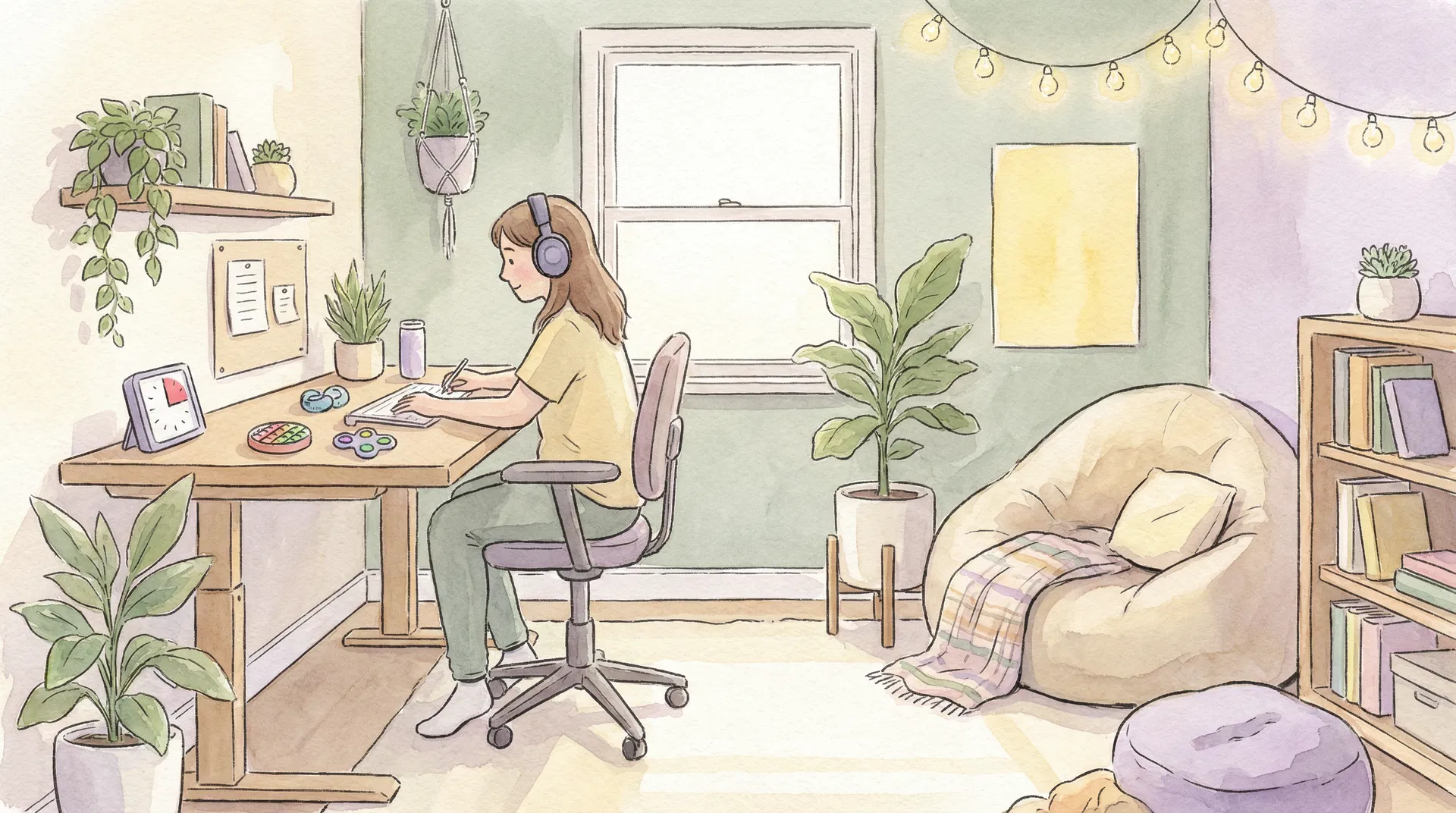
Why Neurodivergent People Need Workplace Accommodations
Let us start with a truth that should not be controversial but somehow still is: most workplaces were not designed for neurodivergent brains. Open-plan offices, rigid 9-to-5 schedules, unwritten social rules, fluorescent lighting, back-to-back meetings, and the expectation of constant availability — these are not neutral design choices. They are choices that happen to work well for many neurotypical people and can be genuinely harmful for many neurodivergent people.
Workplace accommodations are not about getting special treatment or an unfair advantage. They are about removing barriers that prevent you from doing your best work. A person who uses a wheelchair needs a ramp — not because they are less capable, but because the building was designed with stairs. Similarly, a person with ADHD who needs noise-cancelling headphones or an autistic person who needs a written agenda before meetings is not asking for a luxury — they are asking for the equivalent of a ramp.
Research consistently shows that when neurodivergent employees receive appropriate accommodations, their productivity, job satisfaction, and retention rates improve significantly. A 2025 study by the City and Guilds Neurodiversity Index found that 41% of neurodivergent employees navigate workplace barriers on most days, while over half have taken time off due to inadequate support. These are not niche statistics — neurodivergent people make up an estimated 15-20% of the global population.
The business case for accommodations is strong too. Neurodivergent employees often bring exceptional strengths — pattern recognition, creative problem-solving, hyperfocus on areas of interest, attention to detail, and innovative thinking. But these strengths can only emerge in an environment that does not drain all their energy on basic survival.
Know Your Rights: Legal Frameworks Around the World
Before asking for accommodations, it helps to know that in many countries, you have a legal right to them. Here is a brief overview of major legal frameworks — but always check the specific laws in your jurisdiction.
In the United States, the Americans with Disabilities Act (ADA) requires employers with 15 or more employees to provide "reasonable accommodations" for employees with disabilities, including neurodevelopmental conditions like ADHD and autism. The key word is "reasonable" — accommodations that do not cause "undue hardship" to the employer. You do not need a formal diagnosis to request accommodations, though documentation may be required.
In the United Kingdom, the Equality Act 2010 requires employers to make "reasonable adjustments" for disabled employees, and neurodivergent conditions are generally covered. The UK has been particularly progressive in recognizing neurodiversity in the workplace, with the ACAS guidance specifically addressing neurodivergent employees.
In the European Union, the Employment Equality Directive requires member states to prohibit disability discrimination in employment and provide reasonable accommodations. Implementation varies by country, but the principle is consistent across the EU.
In Australia, the Disability Discrimination Act 1992 provides similar protections. In Canada, the Canadian Human Rights Act and provincial human rights codes require accommodation to the point of "undue hardship."
Important note: You do not always need a formal diagnosis to request accommodations. Many employers will work with you based on a description of your needs and how specific changes would help you perform your job. That said, having documentation (from a doctor, psychologist, or psychiatrist) can strengthen your request if there is any pushback.
15 Specific Accommodations Organized by Challenge
Here are concrete accommodations you can request, organized by the challenge they address. Not all of these will apply to you — pick the ones that match your specific needs.
For focus and productivity challenges: Request permission to wear noise-cancelling headphones while working. Ask for a quieter workspace or a desk away from high-traffic areas. Negotiate flexible working hours that align with your peak focus times (many ADHD brains work better in the afternoon or evening). Request written instructions for tasks and projects instead of verbal-only briefings. Ask for larger tasks to be broken into smaller milestones with clear deadlines. Request permission to use productivity tools like visual timers, task management apps, or body doubling services during work hours.
For sensory challenges: Ask for adjustments to lighting at your workstation (a desk lamp instead of overhead fluorescents, or a screen filter). Request a workspace away from strong smells (kitchen, bathroom, heavily perfumed colleagues). Negotiate dress code flexibility if certain fabrics or clothing requirements cause sensory distress. Ask for a quiet room or sensory break space where you can decompress during the day. Request permission to use fidget tools or stim toys at your desk.
For communication challenges: Ask for meeting agendas to be shared in advance so you can prepare. Request that important information be provided in writing (email follow-ups after verbal discussions). Negotiate alternative communication methods — some neurodivergent people communicate better via chat or email than in face-to-face conversations. Ask for clear, explicit feedback rather than hints or implied expectations. Request the option to turn off your camera during video calls when you need to reduce sensory and social processing load.
For energy management: Negotiate work-from-home days to reduce commuting and environmental stress. Request flexible break schedules — the ability to take short breaks when needed rather than at fixed times. Ask for a reduced meeting load or meeting-free blocks of time. Negotiate a gradual return-to-office plan if you are recovering from burnout. Request the ability to adjust your workload during high-stress periods.
How to Ask: Scripts and Email Templates
Asking for accommodations can feel intimidating, especially if you are worried about being seen as difficult, lazy, or incapable. Here are some approaches and templates to make the conversation easier.
Start with your manager if you have a good relationship with them. Frame the conversation around performance and productivity — not diagnosis labels. You might say something like: "I have been thinking about how I can do my best work here, and I have identified a few adjustments that would help me be more productive. Could we discuss them?"
If you prefer to put it in writing, here is an email template you can adapt:
Subject: Request for Workplace Adjustments
Dear [Manager's Name],
I wanted to discuss some adjustments that I believe would help me perform at my best. I have [ADHD / autism / a neurodevelopmental condition] that affects [specific area: focus, sensory processing, energy management — choose what applies].
I have found that the following adjustments significantly improve my productivity and work quality:
- [Specific accommodation 1, e.g., "Permission to wear noise-cancelling headphones during focused work periods"] - [Specific accommodation 2, e.g., "Receiving meeting agendas at least 24 hours in advance"] - [Specific accommodation 3, e.g., "Working from home on Wednesdays to manage sensory load"]
These adjustments would not affect my ability to meet deadlines, collaborate with the team, or fulfill my responsibilities. In fact, I believe they would improve my output.
I am happy to discuss this further and find solutions that work for both of us. I can also provide documentation from my healthcare provider if needed.
Thank you for your understanding.
Best regards, [Your Name]
If your manager is not receptive, escalate to HR or your company's occupational health team. Use the language of your country's disability legislation ("reasonable accommodations" in the US, "reasonable adjustments" in the UK) to signal that you know your rights. You do not need to be confrontational — but you should be clear that this is a legitimate request, not a casual preference.
What to Do If Accommodations Are Denied
Unfortunately, not all accommodation requests are met with understanding. If your request is denied, here are your options.
First, ask for the denial in writing and request a specific reason. Employers are generally required to engage in an "interactive process" — meaning they should discuss alternatives with you rather than simply saying no. If they deny one accommodation, they should offer to explore other options that might address the same need.
Second, escalate within the organization. If your direct manager denied the request, go to HR. If HR is unhelpful, check if your company has a diversity and inclusion team, an employee resource group for disabled or neurodivergent employees, or an occupational health service. Sometimes the issue is ignorance rather than malice, and a different person in the organization may be more knowledgeable.
Third, seek external support. In many countries, there are free advocacy services for disabled employees. In the US, the Job Accommodation Network (JAN) provides free guidance. In the UK, ACAS offers free workplace dispute resolution. Disability rights organizations in your country can often provide advice or connect you with legal support.
Fourth, document everything. Keep records of your requests, the responses you received, and any impact on your work or wellbeing. If the situation escalates to a formal complaint or legal action, documentation is essential.
Finally, know when to walk away. If an employer consistently refuses reasonable accommodations and the environment is harming your health, it may be time to look for a more supportive workplace. This is not giving up — it is choosing to invest your energy in an environment that values you. More and more companies are actively recruiting neurodivergent talent and building inclusive workplaces. You deserve to work somewhere that supports you.
Self-Accommodations You Can Implement Without Asking Anyone
While formal accommodations are important, there are many things you can do right now to make your work life more manageable — no permission required.
Manage your energy, not just your time. Use our Energy Tracker to identify your peak focus hours and schedule your most demanding tasks during those windows. Protect your best hours from meetings and interruptions whenever possible. Schedule less demanding tasks (email, admin, routine work) for your lower-energy periods.
Create your own sensory toolkit. Keep a small bag at your desk with earplugs or earbuds, a fidget toy, sunglasses (for harsh lighting), a comfort snack, a calming essential oil, and any other items that help you regulate. Having these tools within reach means you can intervene at the first sign of overwhelm rather than waiting until you are in crisis.
Use technology to your advantage. Noise-cancelling apps, blue light filters, text-to-speech tools, visual timers, task management apps, and calendar blocking are all tools you can implement without anyone else's involvement. Many are free or low-cost.
Build transition rituals. Neurodivergent brains often struggle with transitions — switching between tasks, moving from home to work mode, or shifting from focused work to a meeting. Create small rituals that signal transitions: a specific song you play before starting work, a short walk between meetings, a breathing exercise before a difficult task. These rituals give your brain a cue to shift gears.
Set boundaries around masking. Masking — suppressing your natural neurodivergent behaviors to appear neurotypical — is exhausting and unsustainable. Look for small ways to reduce masking at work: stimming subtly, being honest about needing processing time, declining unnecessary social events, or simply allowing yourself to be quiet when you do not have the energy for small talk. Every bit of masking you can safely drop is energy you can redirect toward your actual work.
Connect with other neurodivergent people. Whether it is an employee resource group at work, an online community, or a local meetup, connecting with people who understand your experience can be profoundly supportive. You can share strategies, validate each other's experiences, and feel less alone in navigating a neurotypical workplace. The neurodivergent community is one of the most generous and supportive communities out there — and you are welcome in it.
You Might Also Like
 Sensory
Sensory Overload Survival Guide: What It Feels Like and How to Cope
When the world gets too loud, too bright, and too much — this guide explains what sensory overload is, why it happens in neurodivergent brains, and gives you practical coping strategies for home, work, and social situations.
Read article ADHD
ADHDADHD Paralysis: Why You Can't Start Tasks (And 9 Ways to Break Free)
You know what you need to do, but you cannot start. ADHD paralysis is not laziness — it is a neurological bottleneck. Learn about the three types of paralysis, the neuroscience behind the freeze, and 9 practical strategies to break free.
Read articleTrack your energy to identify what accommodations you need
Our Energy Tracker helps you map your daily patterns so you can advocate for the right support.