
Maurício Amaro
Founder & WriterNeurodivergent dad, writer, and chronic tab-hoarder. ADHD & highly gifted. Writes about brains the way he lives — honestly, without the clinical distance.
What Is AuDHD? Understanding the Overlap Between Autism and ADHD
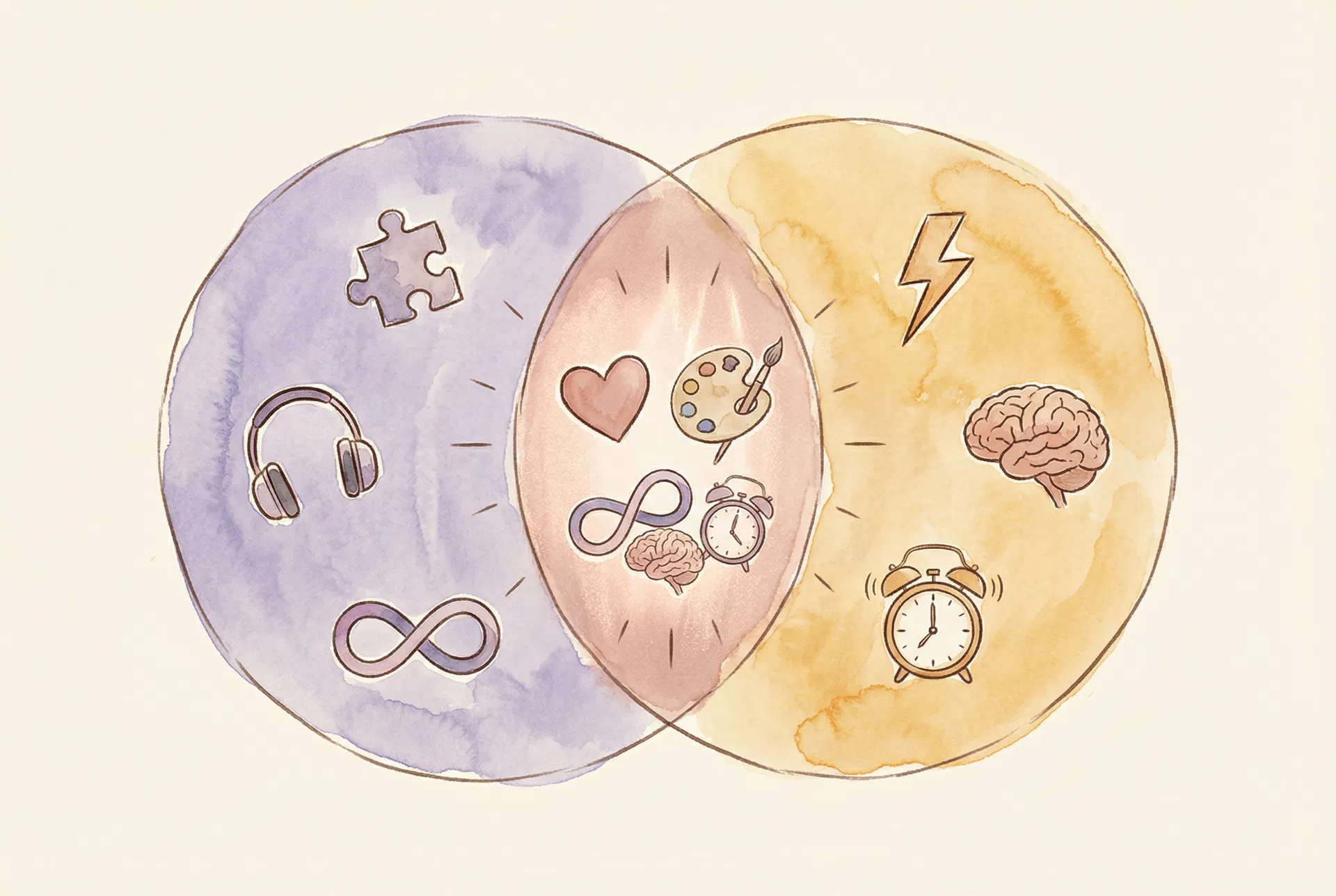
AuDHD refers to having both autism and ADHD simultaneously. It is not a formal diagnosis yet, but it describes a real and distinct neurological experience that affects how both conditions present and interact.
The two conditions share many surface traits — sensory sensitivity, executive dysfunction, social difficulty — but they often pull in opposite directions, creating internal conflicts that are uniquely exhausting.
AuDHD is frequently missed or misdiagnosed because each condition can mask the other. Understanding the overlap is the first step toward getting the right support.
A Brain That Contradicts Itself
If you have ever felt simultaneously desperate for routine and completely unable to maintain one, craving deep connection while finding social interaction utterly draining, hyperfocusing for six hours on something irrelevant while being unable to start the thing that actually matters — you might be living with AuDHD.
AuDHD is the informal but increasingly recognised term for having both autism spectrum condition (ASC) and attention deficit hyperactivity disorder (ADHD) at the same time. It is not a formal diagnostic category yet, but it describes a neurological reality that millions of people live with every day.
For a long time, clinicians believed autism and ADHD were mutually exclusive — that you could not have both. The DSM-IV (the diagnostic manual used until 2013) explicitly prohibited a dual diagnosis. That prohibition was removed in DSM-5, and since then, research has consistently shown that the two conditions co-occur far more often than chance would predict. Current estimates suggest that between 50 and 70 percent of autistic people also meet criteria for ADHD, and between 20 and 50 percent of people with ADHD also meet criteria for autism.
What Autism and ADHD Actually Are
Before exploring the overlap, it helps to understand what each condition involves on its own.
Autism (autism spectrum condition or ASC) is a neurodevelopmental difference characterised by differences in social communication and interaction, restricted or repetitive patterns of behaviour, and often heightened or reduced sensory sensitivity. Autistic people tend to value consistency, depth, and directness. They often have strong pattern recognition, intense areas of interest, and a preference for predictability.
ADHD (attention deficit hyperactivity disorder) is a neurodevelopmental condition characterised by difficulties with sustained attention, impulse control, and executive function. Despite the name, ADHD is not simply about being distracted — it involves a fundamental difference in how the brain regulates attention, motivation, and action. People with ADHD often thrive on novelty, urgency, and interest-driven engagement.
At first glance, these two profiles seem almost opposite. Autism often involves a preference for sameness; ADHD often involves a drive toward novelty. Autism can involve intense focus on rules and systems; ADHD can involve difficulty following rules at all. This apparent contradiction is part of why AuDHD was historically considered impossible — and why it remains so confusing to diagnose and to live with.
The AuDHD Experience: Where They Collide
When autism and ADHD co-occur, the result is not simply the sum of two conditions. The two neurotypes interact, amplify, and sometimes directly contradict each other in ways that create a unique and often exhausting experience.
The routine paradox. Autism often creates a strong need for routine and predictability — the same route to work, the same morning sequence, the same foods. ADHD, meanwhile, creates a drive toward novelty and a tendency to abandon routines the moment they feel stale. AuDHD people often desperately want routine but cannot sustain it. They build systems, then abandon them. They restart the same habits on an endless loop.
The social paradox. Autism can make social interaction cognitively demanding and draining. ADHD can create impulsivity, talkativeness, and a need for social stimulation. AuDHD people may find themselves simultaneously craving connection and being exhausted by it — wanting to be around people but needing to recover afterwards, or talking too much and then needing days of solitude.
The attention paradox. Autism often supports deep, sustained hyperfocus on areas of interest. ADHD creates difficulty sustaining attention on anything that does not provide immediate reward or novelty. AuDHD people can hyperfocus intensely — but only on the right thing, at the right moment, under the right conditions. Everything else may feel impossible to start.
The sensory paradox. Both conditions involve sensory differences, but they can pull in different directions. An autistic person may need a quiet, controlled environment to function. An ADHD brain may need background noise or stimulation to stay regulated. AuDHD people sometimes need both at once — and find neither fully satisfying.
Why AuDHD Is So Often Missed
One of the most significant challenges of AuDHD is that each condition can mask the other — making both harder to identify.
Autistic traits can make ADHD look different. The autistic drive for routine and rule-following can compensate for ADHD impulsivity, making the ADHD less visible. An autistic person who has learned to script their day meticulously may appear to have excellent executive function — until the scaffolding collapses under stress.
ADHD traits can make autism look different. The social impulsivity and talkativeness associated with ADHD can mask the social difficulties associated with autism. A person who talks a lot and seems engaged may not be recognised as autistic, even if every interaction is exhausting and heavily rehearsed.
Gender also plays a significant role. Research consistently shows that autism and ADHD are both underdiagnosed in women, girls, and non-binary people, who are more likely to mask effectively and present atypically. AuDHD women in particular are often diagnosed late — sometimes not until their thirties, forties, or beyond — after years of being told they are anxious, sensitive, or difficult.
The result is that many AuDHD people spend years — sometimes decades — knowing something is different about how their brain works, without ever receiving an explanation that fits.
Masking in AuDHD: Double the Labour
Masking — the process of suppressing or camouflaging neurodivergent traits to appear neurotypical — is common in both autism and ADHD. In AuDHD, it tends to be especially pronounced and especially costly.
Autistic masking involves suppressing stimming, scripting conversations, forcing eye contact, and performing social norms that do not come naturally. ADHD masking involves appearing calm and focused when internally chaotic, suppressing impulsive responses, and performing attentiveness.
For AuDHD people, both layers of masking are often operating simultaneously. The cognitive load is immense. And because masking is so effective, it often delays diagnosis and makes it harder for others — including clinicians — to take the person’s difficulties seriously.
Autistic burnout, which results from sustained masking and overextension, is a significant risk for AuDHD people. It can look like depression, withdrawal, or a sudden loss of previously held skills — and it is often misdiagnosed as such.
Getting a Diagnosis: What to Expect
If you suspect you might be AuDHD, the path to diagnosis can be long and frustrating — but it is worth pursuing.
Currently, there is no single AuDHD diagnosis. You would typically receive separate diagnoses for autism and ADHD, either simultaneously or sequentially. The order matters: if ADHD is diagnosed first, autism may be missed if the clinician is not looking for it. If autism is diagnosed first, ADHD symptoms may be attributed to autism rather than assessed independently.
For the best outcome, seek a clinician who is experienced with both conditions and explicitly familiar with co-occurring presentations. Ask directly: “Will you assess for both autism and ADHD?”
In the UK, NHS waiting lists for autism and ADHD assessments can be extremely long — often several years. Private assessments are available but costly. Many people pursue a private ADHD assessment first (which tends to be faster and less expensive) and then seek an autism assessment separately.
Self-diagnosis is also increasingly recognised within the neurodivergent community as valid and meaningful, particularly for those who cannot access formal assessment. Understanding your own neurology — even without a formal diagnosis — can be genuinely transformative.
Strengths of the AuDHD Brain
AuDHD is not only a list of challenges. The same brain that creates paradoxes and contradictions also tends to produce remarkable strengths.
Pattern recognition. The combination of autistic attention to detail and ADHD-driven novelty-seeking often produces exceptional ability to spot patterns, connections, and inconsistencies that others miss.
Hyperfocus + depth. When an AuDHD person finds a topic that engages both their autistic interest system and their ADHD novelty drive, the resulting focus can be extraordinary. Many AuDHD people describe being able to go deeper into a subject than almost anyone they know.
Creative thinking. The AuDHD brain tends to make unusual connections, challenge assumptions, and approach problems from unexpected angles. Many AuDHD people are highly creative, innovative, and original thinkers.
Empathy and justice sensitivity. Both autism and ADHD are associated with strong moral reasoning and sensitivity to injustice. AuDHD people often have a fierce, uncompromising sense of fairness and a deep capacity for empathy — even when social interaction itself is difficult.
Resilience. Having navigated a world that was not designed for your brain, often without support or understanding, AuDHD people tend to develop remarkable adaptability, problem-solving skills, and self-awareness.
Living Well with AuDHD: Practical Starting Points
There is no single formula for thriving with AuDHD, but there are principles that many AuDHD people find helpful.
Work with your interest system, not against it. AuDHD brains are interest-driven. Rather than forcing yourself to engage with things that do not activate your interest, look for ways to connect necessary tasks to things you genuinely care about.
Build flexible structure. Rigid routines often fail because ADHD disrupts them. Flexible structure — loose frameworks with room for variation — tends to work better. Think: a morning sequence with optional steps, not a minute-by-minute schedule.
Protect your sensory environment. Both autism and ADHD are affected by sensory input. Identify your sensory needs and advocate for them. Noise-cancelling headphones, adjusted lighting, and designated quiet spaces are not luxuries — they are support tools.
Name the paradoxes. When you notice yourself caught between two opposing needs — wanting routine but craving novelty, wanting connection but needing solitude — naming it as an AuDHD paradox can reduce the self-blame. You are not broken. Your brain is running two operating systems simultaneously.
Seek community. The AuDHD community online is active, warm, and deeply knowledgeable. Finding others who share your experience can be profoundly validating — and practically useful.
Related Articles
 Autism
Autistic Masking: What It Is and Why It's So Exhausting
Masking is the invisible labour of performing neurotypicality. Millions of autistic people do it every day — and it comes at a serious cost. Learn what masking is, why it happens, and how to start unmasking safely.
Read article ADHD
ADHDWhat Is ADHD Time Blindness? 7 Tips That Actually Help
ADHD time blindness is not about forgetting — it is a neurological difference in how the brain perceives time. Learn what causes it and 7 practical strategies to manage time when your brain works differently.
Read article Autism
Autistic Meltdown vs Shutdown: What's the Difference?
Both are involuntary responses to overwhelm — but they look completely different from the outside. Learn what distinguishes a meltdown from a shutdown, what causes each, and how to support an autistic person (or yourself) through both.
Read article Workplace
Neurodivergent at Work: A Practical Guide to Accommodations You Can Actually Ask For
Most workplaces were not designed for neurodivergent brains. This guide covers 15 specific accommodations you can request, how to ask (with email templates), your legal rights, and self-accommodations you can implement today.
Read article Sensory
Sensory Overload Survival Guide: What It Feels Like and How to Cope
When the world gets too loud, too bright, and too much — this guide explains what sensory overload is, why it happens in neurodivergent brains, and gives you practical coping strategies for home, work, and social situations.
Read article ADHD
ADHDADHD Paralysis: Why You Can't Start Tasks (And 9 Ways to Break Free)
You know what you need to do, but you cannot start. ADHD paralysis is not laziness — it is a neurological bottleneck. Learn about the three types of paralysis, the neuroscience behind the freeze, and 9 practical strategies to break free.
Read article Neurodiversity
Understanding Your Neurodivergent Brain: A Beginner's Guide
Whether you have just been diagnosed, are self-identified, or are simply curious, this guide walks you through what neurodivergence means, the different neurotypes, and how to start building a life that works with your brain instead of against it.
Read article- 1Review2016
The Co-occurrence of Autism Spectrum and Attention-Deficit/Hyperactivity Disorders: A Review
Antshel, K.M. et al. — Current Psychiatry Reports
- 2Review2014
Leitner, Y. — Frontiers in Human Neuroscience
- 3Study2010
Shared Heritability of Attention-Deficit/Hyperactivity Disorder and Autism Spectrum Disorder
Rommelse, N.N. et al. — European Child & Adolescent Psychiatry
- 4Study2015
Identifying the Lost Generation of Adults with Autism Spectrum Conditions
Lai, M.C. & Baron-Cohen, S. — The Lancet Psychiatry
- 5Book2013
Diagnostic and Statistical Manual of Mental Disorders, Fifth Edition (DSM-5)
American Psychiatric Association — APA
- 6
All external links open in a new tab. The NDBourhood does not endorse any specific treatment or service.
About the Author
Maurício is a neurodivergent dad, writer, and the person who stays up too late reading research papers about dopamine and then forgets to save the tab. He has ADHD and is highly gifted — which mostly means his brain is running seventeen tabs at once, one of which is always a video game soundtrack. He writes about neurodivergence the way he lives it: honestly, without the clinical distance, and with a deep belief that understanding your own brain is one of the most radical acts of self-care there is.
More about usYour brain is not broken — it is doubly wired
Our free tools are built for neurodivergent minds. Whether you need help with focus, energy, or emotional regulation, we have something for you.